WMS Load Planning Integration
Generate Load Plans When the Final Pallet Is Picked
Loadly is WMS integration ready. Connect through site-approved APIs, SFTP, CSV, or approved data feeds, and when the final pallet is picked, Loadly can receive the completed load and generate an axle-balanced trailer plan automatically — ready before loading begins.
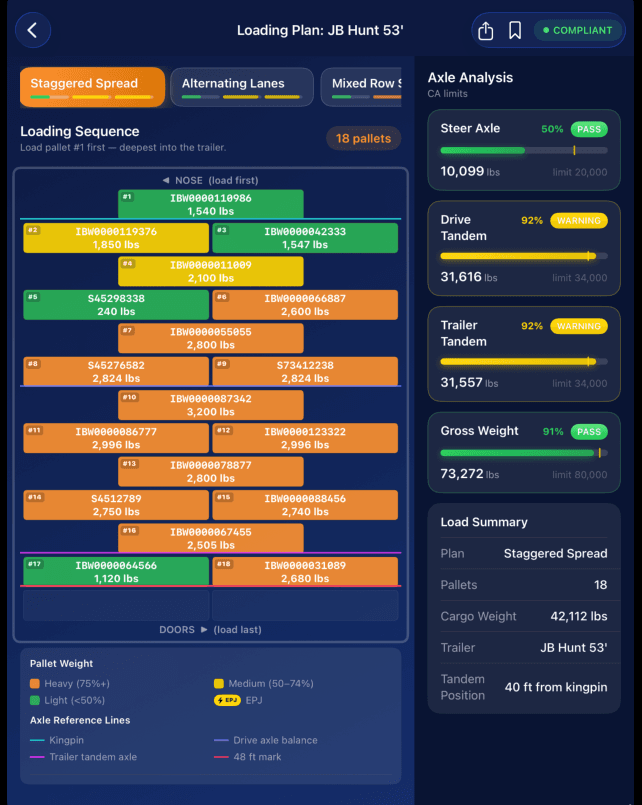
The load plan should be ready when the freight is ready
On most docks, planning is a manual gap. The WMS knows exactly what was picked, but that data is re-keyed, printed to a spreadsheet, or figured out at the trailer — which delays loading and invites last-minute decisions. WMS load planning integration removes that gap.
When Loadly is connected to your WMS or TMS, the completed picked load flows straight into Loadly, and the axle-balanced trailer plan is generated automatically. No waiting on spreadsheets, no manual pallet entry.
What Loadly imports
Once access is approved, Loadly can receive the completed load data your dock needs to plan and execute — the same fields your WMS already tracks — and turn them into a dock-ready plan.
- LPNs and pallet weights
- Destinations and stops
- Trailer, door, and load ID
- Everything needed to generate an axle-balanced plan automatically
Integration methods and the WMS relationship
Loadly supports API, SFTP, CSV, and site-approved integration methods, so it can fit the access your IT and site teams are comfortable approving. The goal is a clean, one-directional handoff of completed load data — not a rip-and-replace project.
Loadly does not replace your WMS. Your WMS manages orders, inventory, picking, and shipping data. Loadly is the execution layer that plans, balances, documents, reconciles, and improves the outbound load — keeping the WMS as the system of record.
- Pull completed load data directly from your WMS or TMS
- Generate dock-ready load plans when the final pallet is picked
- Reduce manual entry, planning delays, and last-minute load decisions
- Support API, SFTP, CSV, and site-approved integration methods
- Keep Loadly as the execution layer without replacing the WMS
Frequently asked questions
Yes. Loadly is WMS integration ready and can connect through site-approved APIs, SFTP, CSV, or approved data feeds. Once access is approved, Loadly can receive completed load data such as LPNs, pallet weights, destinations, stops, trailer, door, and load ID.
Yes. When connected to your WMS or approved data feed, Loadly can receive the completed picked load and automatically generate an axle-balanced trailer plan for the dock team.
No. Loadly sits between your WMS and the driver leaving the yard. Your WMS manages orders, inventory, picking, and shipping data. Loadly helps execute the outbound load plan, balance the trailer, document the load, and track scale and rework events.
Loadly supports API, SFTP, CSV, and site-approved integration methods, chosen to fit the access your IT and site teams approve.
The execution layer between your WMS and the driver leaving the yard.
Plan. Balance. Execute. Document. Improve.