Axle Weight Load Planning
Axle-Balanced Trailer Load Planning
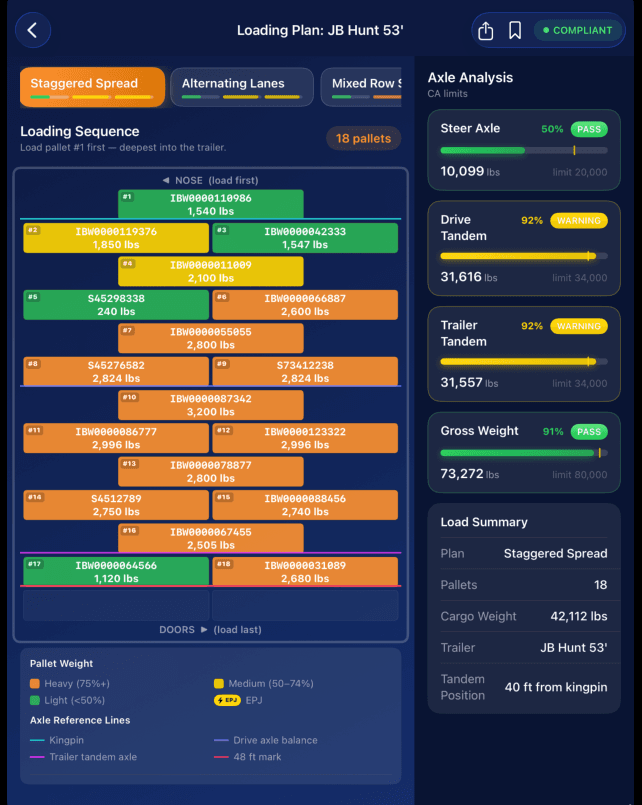
Loadly plans trailers around axle weight, not just cube. It estimates steer, drive, tandem, gross, and payload utilization before dispatch — configured for your tractors, trailers, and jurisdiction — so trailers roll onto the scale ready.
Why axle weight matters more than total weight
A trailer can be under its gross limit and still be illegal. Weight that sits too far forward overloads the drive axles; too far back overloads the trailer tandems. Because axle limits are separate from the gross limit, a load that looks fine on paper can still fail at the scale house and trigger a fine, a re-work, and lost hours.
Axle weight load planning solves this by placing pallets so weight is distributed correctly across each axle group before the trailer ever moves. Loadly models the tractor, the trailer, the kingpin and tandem geometry, and the pallet weights to estimate where each axle group lands.
How Loadly estimates axle weights
For each load, Loadly generates multiple axle-aware loading strategies and ranks them by weight distribution, trailer utilization, stop sequence, and your configured compliance limits. As pallets are placed — or moved during live adjustments — Loadly recalculates the steer, drive, tandem, gross, and utilization estimates in real time.
The estimates are built around your equipment. Loadly can be configured for federal, state, provincial, customer, and fleet-specific limits, and for different tractor and trailer profiles, so the numbers reflect the rig that is actually pulling the load.
- Steer, drive, tandem, gross, and payload-utilization estimates
- Configurable tractor and trailer profiles
- Federal, state, provincial, customer, and fleet-specific limits
- Live re-balancing as pallets are moved on the trailer map
- Multiple ranked loading strategies per load
Scale-ready, then scale-verified
Planning for axle weight gets the trailer close before it reaches the scale. Loadly then closes the loop: drivers upload a scale-ticket photo, Loadly records the actual steer, drive, tandem, and gross weights against the plan, and flags any overweight or high-risk axle group.
If the trailer scales overweight, Loadly creates a rework loop that requires correction, re-scaling, and a new scale-ticket photo before the load can be marked ready for delivery. Over time, historical scale results help refine your trailer and tractor profiles.
Frequently asked questions
Loadly includes axle weight estimation as part of load planning. It estimates steer, drive, tandem, gross, and utilization for each plan based on your configured tractor, trailer, and jurisdiction settings, and recalculates live as pallets move.
Loadly provides scale-ready estimates configured to your equipment and limits. Actual results depend on accurate pallet weight data and following the plan; Loadly also reconciles the real scale ticket against the plan after the fact.
Yes. Loadly can be configured for federal, state, provincial, customer, and fleet-specific limits, and for multiple tractor and trailer profiles.
Loadly flags the overweight axle group and can require a rework and re-scale loop, with a new scale-ticket photo, before the load is marked ready for delivery.
The execution layer between your WMS and the driver leaving the yard.
Plan. Balance. Execute. Document. Improve.